

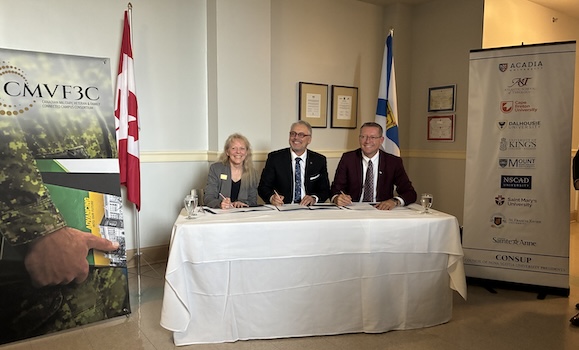
Nova Scotia's universities have taken a significant step toward improving access to higher education for military members, veterans, reservists and their families through a landmark agreement signed Wednesday, June 24 in Halifax at the University of King鈥檚 College.
In late June, the (CONSUP) and the (CMVF3C) signed a memorandum of understanding (MOU) establishing a province-wide framework to better support military-connected learners across Nova Scotia's 10 public universities. The agreement is the first of its kind in Canada and reflects a shared commitment to expanding post-secondary opportunities for Canada's military community.
9 1免费版下 President and Vice-Chancellor Dr. Kim Brooks joined fellow university presidents from across the province at the event and signed the agreement on behalf of 9 1免费版下.
Removing barriers for military-connected learners
听
Nova Scotia is home to more than 13,000 military personnel and 1,600 reservists, with those numbers expected to grow in the coming years as the province's role as a national centre for defence, security and innovation continues to expand. Military service often involves frequent relocations, career transitions and periods of deployment that can make pursuing higher education challenging. The MOU establishes a coordinated approach across Nova Scotia's universities to help remove barriers and create more seamless pathways for military-connected learners.
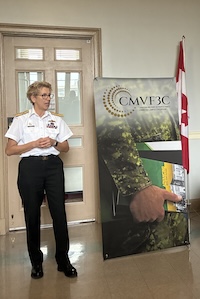
Rear Admiral Jos茅e Kurtz (shown right), commander Maritime Forces Atlantic and Joint Task Force Atlantic, welcomed the agreement. "This memorandum, this consortium, is part of the potential that is yet to be explored, and I can't wait to see where it goes,鈥� he said. 鈥淭o all of you leaders in your respective environments, a big 鈥榯hank you鈥� on behalf of all our people in the Canadian Armed Forces."
Under the agreement, CONSUP members will:
- Recognize skills, training and qualifications acquired through military service to support academic pathways;
- Assist military members and families who transfer between institutions because of postings or relocation; and
- Strengthen campus-based supports and services that contribute to student success and well-being.
Dr. Andy Hakin, chair of CONSUP and president of St. Francis Xavier University, said the agreement builds on a long tradition of welcoming military learners while creating new opportunities for collaboration among institutions.
"We are delighted to enter into an MOU with CMVF3C,鈥� said Dr. Hakin. 鈥淣ova Scotia universities have a long history of welcoming military personnel and their families. This MOU brings our 10 universities together to move quickly to support the expansion of military learners, and to share best practices, to learn from one another, and to offer a welcoming and high-quality university experience regardless of the chosen university."
Building on a national movement
听
The agreement builds upon the growing Military and Veteran Friendly Campus movement across Canada. The CMVF3C network emerged from efforts led by the University of Alberta to create more welcoming and effective pathways for military-connected students. The consortium now works with post-secondary institutions, the Canadian Armed Forces, Veterans Affairs Canada and a range of community partners to improve coordination and support student success.
Dr. Suzette Br茅mault-Phillips, chair of the CMVF3C and a professor in the University of Alberta's Faculty of Rehabilitation Medicine, described the agreement as an important example of provincial leadership.
"Nova Scotia is leading the way with a first-of-its-kind provincial commitment to military-connected learners. We hope today's agreement inspires other provinces and territories to build similar partnerships and create a network of support for military members, veterans and their families across Canada."
There is already interest from other Atlantic universities in pursuing similar agreements in their respective provinces.
What鈥檚 next
听
Over the coming months, Nova Scotia's universities will hope to build on the MOU by exploring further opportunities for collaboration to support veterans. By working together, Nova Scotia鈥檚 universities hope to make it easier for military members, veterans and their families to pursue their educational goals, while contributing to the province鈥檚 broader strengths in defence, security, research and innovation.
The agreement also builds on existing 9 1免费版下 supports for military-connected students, including a long-standing partnership between the Faculty of Open Learning and Career Development and the Naval Fleet School Atlantic at Stadacona Base in Halifax. This program provides specialized, in-person instruction to meet the training needs of Canadian Navy recruits and active personnel, with courses spanning areas such as engineering, electrical theory, control systems, technical communication, project management and learning strategies.
The Faculty also offers flexible professional development, pathway programming, recognition of prior learning and microcredentials that can help learners build on previous training and experience as they pursue further education or career advancement.
鈥淭his type of partnership reflects our civic mission in action,鈥� says Jennifer Hann, Dean (Acting) of the Faculty of Open Learning and Career Development. 鈥淚t鈥檚 highly specialized, mission-driven education that鈥檚 responsive to public and national interests. It鈥檚 one way we are helping extend 9 1免费版下鈥檚 reach beyond Nova Scotia and into national and international contexts.鈥�
Do you support military-connected learners in your Faculty or unit? If so, we want to know. Please reach out to provost@dal.ca to share more about your efforts.