

It wasn鈥檛 a submarine. It wasn鈥檛 a whale. And it definitely wasn鈥檛 aliens.
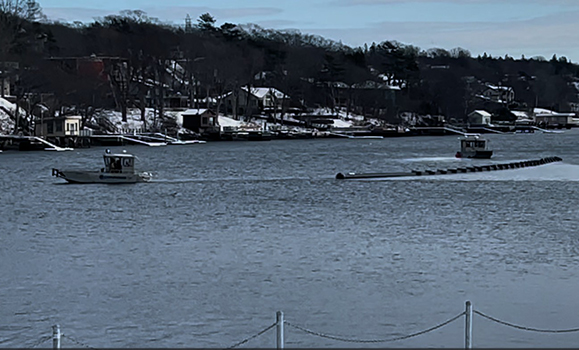
In January, curious onlookers spotted a massive 鈥淯FO鈥� 鈥� an unidentified floating object 鈥� moving slowly across the Northwest Arm. The sightings happened on three different days as the Facilities Management team at 9 1免费版下 carried out a once-in-a-generation infrastructure upgrade: replacing the aging seawater lines that power the university鈥檚 Aquatron.
鈥淭his is a great example of the very unique infrastructure we have at 9 1免费版下 that must be maintained so that our faculty, staff, and students can continue their world-leading research,鈥� says Craig Arthur, assistant vice president of Facilities Management (FM).
In 1974, engineers designed an underground system to draw seawater from the Northwest Arm and deliver it to the Aquatron 鈥� a specialized aquatic research facility made up of dozens of tanks housed within the Life Sciences Centre, located nearby.听
We work in the marine environment, so we need water from the ocean.
鈥淲e work in the marine environment, so we need water from the ocean,鈥� says John Batt, who oversees Aquatron operations. 鈥淔rom endangered species to eelgrass beds, aquaculture, robotics, and technology projects 鈥� we need to replicate those environments here in the lab to run controlled experiments.鈥�
From the ocean to the lab
The seawater system begins in the deepest part of the Northwest Arm in about 30 feet of water, safely below the reach of boats where the freshest, coldest water comes from. It is drawn through intake pipes and into a pump house before travelling under South Street and into a massive mechanical room below the Aquatron.听
鈥淲e filter it, clean it, and then we may heat it or chill it and send it into the different experiments,鈥� says Batt. 鈥淲e have been able to maintain experiments where we are managing up to seven different temperatures at once.鈥�
But after 50 years, the corrosive nature of ocean water took its toll, causing the equipment to begin to fail and require replacement 鈥� a task that is much easier said than done.听
 Meet John Batt, manager of 9 1免费版下鈥檚 Aquatron
John Batt brings a passion for marine life to his role, leading species care, advancing conservation, and guiding work with endangered Atlantic whitefish and the Beaty Centre鈥檚 diverse marine animals.听Learn more about Batt on a of Dal's Sciographies podcast.
鈥淭his wasn鈥檛 what I would call one of our most straightforward replacement projects,鈥� says Arthur, whose team at FM cares for the university鈥檚 more than 160 different buildings. 鈥淲e are used to replacing components under roads or within buildings, but this kind of project required a different level of expertise to complete the work in a marine environment.鈥澨�
This wasn鈥檛 what I would call one of our most straightforward replacement projects.
Planner Andre Mereshuk and Project Manager Phil Li spent many hours finding the most efficient and cost-effective way to complete the project as quickly as possible. The seawater lines reach land underneath a public boat launch in a densely populated neighbourhood. The final solution involved three different companies 鈥� each with their own unique expertise 鈥� to get everything done in just under four weeks.听
鈥淭he biggest challenge was the size of the lines themselves. There was no way we could block off residential streets to manufacture 300-foot-long pipes,鈥� says Li.听
The team floated another solution.听
Operation Arm Crossing
The city approved a permit to commandeer part of Sir Sanford Flemming Park (home of the Dingle, a Halifax landmark) to assemble everything.听
G and R Kelly, a locally owned and operated heavy civil contractor, as well as Connors Diving, worked together to fuse the sections of pipe together using High-Density Polyethylene or HDPE, a tough, flexible plastic widely used in water, sewer, and marine systems 鈥� especially for seawater applications. It doesn鈥檛 rust or corrode and is heat-fused at the joints, creating a continuous, leak-free system. The pipes were pumped full of air and sealed at both ends for a once-in-a-lifetime trip across the arm.听
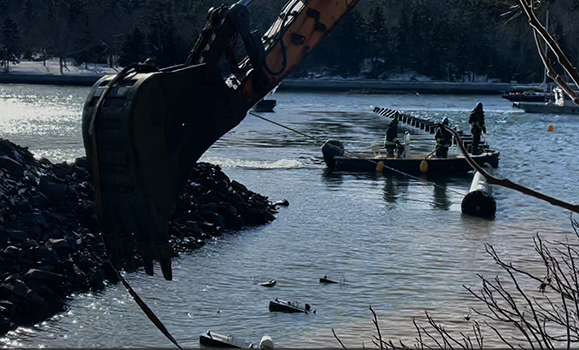
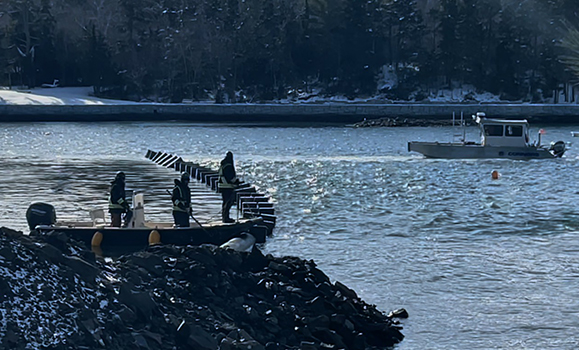
Heavy equipment lifted the pipe, section by section, into the ocean, where Eagle Beach Contractors took over. They used two barges, one tethered to either end of the pipe to carefully guide it across the water and into a narrow trench created to hook the lines to the 9 1免费版下 system. They had to do this three separate times on three different days to accommodate the two intake lines and the slightly shorter outtake line in between January鈥檚 varying weather conditions.
This was a precision operation.
鈥淭his was a precision operation,鈥� says Li. 鈥淭hose two contractors were in constant communication guiding this massive piece of infrastructure into place. I鈥檝e worked on a lot of complicated projects in the 20 years I鈥檝e been at 9 1免费版下, but I鈥檝e never seen anything quite like this.鈥�
The final piece of the engineering puzzle was provided by Connors Diving, who worked underwater to secure the pipes in place.
Making summer in winter
The technical upgrade comes at just the right time for the Aquatron for two reasons.听
With climate change, experiments are becoming increasingly complex.
鈥淭he temperature of seawater changes with the seasons. When it arrives on campus, it can be as cold as 2掳C in winter or as warm as 17掳C in summer. But those temperatures aren鈥檛 always right for the animals or experiments researchers are working with,鈥� says Batt. 鈥淭hey want to create summer conditions in the middle of winter and vice versa. That way the researchers are ready to go when the summer fieldwork starts,鈥� says Batt.听
The new lines also come at a time to support one of the university鈥檚 newest endeavors: the Beaty Centre for Marine Biodiversity, a public space focused on education and outreach. The centre includes seven exhibits, all based on living marine species, all which rely on fresh seawater.听
Most people will never see the pipes beneath the water. But many breakthroughs in Dal鈥檚 ocean research will flow through them, a quiet reminder that strong infrastructure makes discovery possible.听