

ANYA WAITE鈥橲 expectations for a life in research and academia didn鈥檛 start in a classroom or a lab. They were formed at the dinner table.
Her family鈥檚 dinner table in Halifax, to be more precise. There, her mother Masha鈥攁 biologist鈥攁nd her father Peter鈥攁 Canadian political historian and renowned Dal professor鈥攚ould frequently invite faculty colleagues over for drink, dining, and discourse. And from a very young age, Anya soaked it all in鈥攎inus the wine, of course.
鈥淲e had philosophy professors, economists, chemists, people from across the Dal community,鈥� she says. 鈥淢y father was one of the first in his family to get a university degree. So, for him, it was the joy of just being part of an intellectual community, where you could talk ideas. There was a lot of laughter鈥攖hey took themselves seriously but not too seriously, and it rarely became didactic or fierce. It was a truly rich experience.鈥�
Further reading: 9 1免费版下 Originals: Peter Busby Waite
Those memories stuck with the younger Waite as she pursued her own academic journey鈥攏ot plowing into the study of parliaments and politics like her father, but diving into the world below the ocean waves, one of coral and currents.
After years as an acclaimed scientist and global community-builder in oceanographic research, Dr. Waite has found her way back to Halifax and 9 1免费版下, becoming the university鈥檚 associate vice-president research (ocean) and scientific director and CEO of the Dal-led . Now, she鈥檚 the one hosting the table, so to speak, welcoming experts from across disciplines to apply their intellectual rigour and innovative thinking to some of ocean research鈥檚 greatest challenges.
Further reading: Meet the Leadership Team: Anya Waite, Associate Vice鈥怭resident Research (Ocean) and OFI Scientific Director
鈥淚t really isn鈥檛 an overstatement to say Anya is dedicated to saving the world,鈥� says Dr. Alice Aiken, 9 1免费版下鈥檚 vice-president of research and innovation and the one who recruited Dr. Waite to her current role. 鈥淪he knows how important the ocean is to our climate future. From oceanographers and atmospheric scientists to legal and Indigenous scholars, she鈥檚 bringing together researchers uniquely qualified the world over to tackle the problem. And it鈥檚 only because of her excellence as a researcher and passion as a leader that she鈥檚 able to achieve that.鈥�
THE PATH to where Dr. Waite is now has been anything but straightforward鈥攎ore akin to the tossing of a current that, chaotic as it may seem in the moment, ended up exactly where it was supposed to be headed.
She started as a Dal music student before switching to a combined honours in English and Biology, unwilling to choose between the arts and the sciences. Over time, though, she was increasingly drawn to the natural world, doing an honours research project with biologist Bill Freedman and spending her summer tramping through rural Nova Scotia studying how forests regenerate after clear cutting. At that time, she was also volunteering with a marine ecology course and had the opportunity to do work on a research ship.
鈥淎nd I immediately fell in love with being at sea,鈥� she recalls. 鈥淭he steel-toed boots, the hard hat, the whole thing. It was the teamwork on the ship that really got me鈥� it鈥檚 amazing, everyone supporting each other, working really hard and pulling together.鈥�
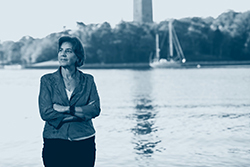 She鈥檇 spend the next couple of decades searching for ways to combine that sense of teamwork with the intellectual curiosity she valued so much. It wasn鈥檛 always easy. After completing her PhD in oceanography at the University of British Columbia, she secured a prestigious postdoctoral fellowship鈥攁nd found the experience completely demoralizing.
鈥淚 grew up with the view that the whole point of being an academic is that you have good arguments, and you bring clear-headed thinking and creativity into these discussions. And instead, what I found was a community that was kind of seized up with the need to bring in big grant money and being worried about sharing ideas in case the lab next door might take them.鈥�
It wouldn鈥檛 be the last time she found herself in a dispiriting career situation. Years later, as an environmental engineering professor in Perth, Australia, a leadership turnover led to her courses being dropped, her teaching load tripled, and coming face-to-face with the sexism that all too often has followed women in the sciences. She doubted her academic self-worth, her leadership, her research. It took escaping to a change of scenery in Germany to realize the problem wasn鈥檛 her.
鈥淚t was almost as if I went from pariah to princess,鈥� she says with a reflective laugh. 鈥淪uddenly I was a female leader of a department which had never had a female leader. I was voted as the top professor to lead the Scientific Council of the whole organization. I got to travel around Germany championing ocean research for the Helmholtz Institutes, influencing the scientific direction of an entire country.鈥�
Ever since, she鈥檚 been lucky to work with female leaders she calls 鈥渢he wind at my back.鈥� She鈥檚 steadfast on her commitment to ensuring debate and discourse is fair, collegial, and intellectually empowering. And the experiences inspired advice she often gives to young women entering a career in research: don鈥檛 neglect your politics.
鈥淢ap your landscape. You鈥檙e never above the politics. Map the mountains. Map the passes. 鈥楬ere be dragons.鈥� Who are the gatekeepers? Ask those questions about the political landscape you鈥檙e working through because you may have to dodge someone, you may have to climb over a pass. All those things are necessary to succeed.鈥�
Dr. Waite returned to her alma mater at a time when Dal is truly making waves in the field.
Ocean research initiatives hosted at Dal鈥攍ike the marine-life surveying and ocean-risk assessing 鈥攁re linking Dal experts with like-minded colleagues and institutions around the globe. The university鈥檚 research strategic direction places 鈥�sustainable ocean鈥� as one of its five central pillars, with an ocean research strategy (launched in 2021) that positions Dal as 鈥渁 global leader in solving ocean challenges through excellence in research, graduate education and innovation.鈥�
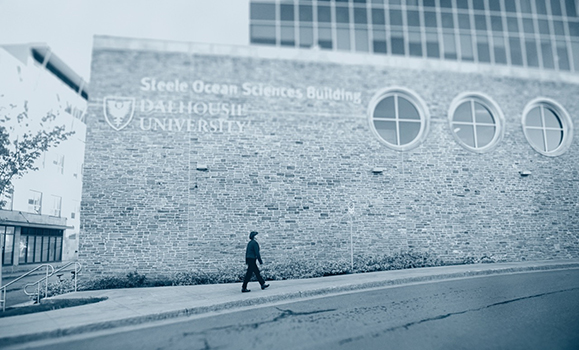
Dr. Waite says she鈥檚 been lucky to work with female leaders she calls 鈥渢he wind at my back.鈥�
A BIG part of that vision is the Ocean Frontier Institute (OFI), a $220-million partnership led by 9 1免费版下, Memorial University of Newfoundland, and the University of Prince Edward Island. Launched in 2016, the institute funds and supports research focused on the North Atlantic and Canadian Arctic Gateway, from understanding atmosphere-ocean interaction to developing sustainable, competitive ocean technologies and solutions. Since taking over as OFI鈥檚 scientific director in 2018, Dr. Waite has worked to enrich the institute鈥檚 activities鈥攇rowing multidisciplinary research, strengthening Indigenous engagement, and pushing boundaries into new frontiers. She cites the project as a great example: a collaboration that uses both community-engaged research and scientific methods to co-produce knowledge on how climate change impacts Northern communities that depend on marine resources.
鈥淗ere鈥檚 a type of project that wouldn鈥檛 necessarily happen without OFI鈥攐r if it did, it probably wouldn鈥檛 happen the same way,鈥� she explains. 鈥淚t鈥檚 probably the biggest project of its kind, blending traditional western science and Indigenous knowledge in a way that focuses not only on traditional academic metrics, like papers, but on how well this research aligns with the local communities. How is the conversation going? That鈥檚 critical.鈥�
Among the conversations Dr. Waite is most focused on right now is one that might be her largest to date: a proposal for a new Dal-led research collaboration called . The project, in partnership with the Universit茅 du Qu茅bec 脿 Rimouski, Universit茅 Laval, and Memorial University, is seeking funding from the Canada First Research Excellence Fund at a scale larger than anything in Dal鈥檚 history. Its vision: to provide critical data and insight to Canada and other countries about the critical role the ocean plays in responding to and managing global climate change鈥攑erhaps the most existential challenge our society, and our planet, is facing.
Further reading: Transforming climate action: 9 1免费版下鈥檚 push to put the ocean at the centre of the global climate conversation
鈥淭he ocean is not well understood as a climate actor, by policy makers or the broader public,鈥� explains Dr. Waite. 鈥淲e think of it as a victim鈥斺�榯he poor ocean, it鈥檚 hurting under climate change鈥欌�攂ut the ocean actually controls climate. It鈥檚 a carbon sink. And if countries like Canada are going to meet our global climate targets, if we鈥檙e going to achieve net-zero carbon emissions, what we鈥檒l need is a significant push for ocean observation, making sure we fully understand the ocean鈥檚 carbon cycles and working to better predict the future climate.鈥�
The project is already attracting support and partners around the world as it ramps up, and Dr. Waite is proud that the spirit of collegiality and collaboration that鈥檚 been foundational to her career is all over the proposal.
鈥淲e鈥檙e creating a space for researchers to talk ideas, where their ideas are going to be valued. We don鈥檛 always get it right, but we try. The whole aim of the proposal was to create a space for intellectual excitement, and we want to continue to do that going forward. And we鈥檙e really looking to engage the next generation of researchers to take charge of this and push it forward.鈥�
Further reading: Ocean Frontier Institute to call for ocean鈥恈limate action at COP27 in Egypt
Over the longer term, she hopes to see the next generation of scientists fully at the helm.
And where will that ultimately leave her? 鈥淢y hope would be that I will always contribute to a constructive, active dialogue: 鈥楲et鈥檚 have that exciting conversation. Let鈥檚 talk science. Let鈥檚 have the inspirational discussion over a glass of wine that鈥檚 going to help envision the next transformative action.鈥欌��
听
This story appeared in the DAL Magazine Fall 2022 issue. Flip through the rest of the Fall 2022 issue using the links below.