
 |
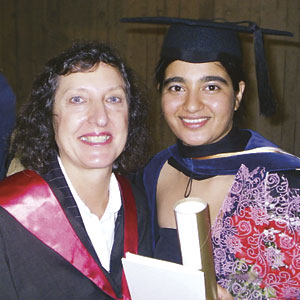
Using the latest DNA technology to study one of the strains of bacteria recovered from the Titanic脮s rusticles, Dr. Henrietta Mann, of 9 1免费版下脮s Faculty of Engineering, and former graduate student, Dr. Bhavleen Kaur, have discovered a new species of bacteria.聽
That the 9 1免费版下 researchers were the first to discover the new species was just recently confirmed. 脪This news was almost as exciting as doing the actual research,鈥� said Dr. Mann.
When asked what they named their discovery, Dr. Mann said, 脪we named it BH1, after ourselves, Bhavleen and Henrietta.鈥澛� This name is temporary, until the scientific community determines a permanent one. The new species, BH1, belongs to the genus Halomonas of the family Halomonadaceae.聽聽
聽For Dr. Kaur, 脪finding out that the bacteria I was studying was a previously unidentified species, was a delicious icing on my research cake. Working with DNA was so exciting. Sequencing the gene of the BH1 strain and then trying to find a match in the Genbank database available on the National Center for Biotechnology Information (NCBI) website, gave me an opportunity to learn and use molecular biology techniques.鈥�
Identifying the new bacterial species was just the first step. Next, the two researchers had to determine if they had discovered, 脪a good bacteria or a bad bacteria,鈥� said Dr. Mann.聽 脪So we tried to find out if strain BH1 had bio-corrosive ability.鈥澛犅�
脪We did this by putting a bacteria sample on the surface of small metal tags, we call coupons,鈥� explains Dr. Mann. 脪The BH1 cells stuck to the surface of these coupons and eventually destroyed the metal. So we knew we had a bad bacteria鈥�
脪These bacteria can seriously damage ship and pipeline structures,鈥� she continued. 脪Therefore, it would be a good idea to continue to study these bacteria in more depth.鈥�
脪If we could discover a way to hold back or stop the bacteria from eating the metal,鈥� explained Dr. Mann, 脪we could help the maritime industry avoid heavy replacement costs to their ships and pipelines. This work was started in biological engineering, but is very important to civil engineers in industry.鈥�
Today the BH1 bacteria are kept under controlled conditions at the American Type Culture Collection (ATCC).聽 脪Eventually we may hopefully obtain the funds to continue this research,鈥� said Dr. Mann. 脪Until then it is safe and is available to other researchers as well.鈥�
On the night of April 14, 1912 the Titanic became the largest underwater metal structure. For the past 86 years it has been slowly eaten by the rusticles. 脪Eventually nothing will remain but a rust stain on the ocean floor,鈥� said Dr. Mann. 脪Everything will be recycled back to nature.鈥澛�
Under the supervision of Dr. Mann, the study of the BH1 bacterial culture was the focus of Dr. Kaur脮s doctoral thesis in Biological Engineering. 脪I love science and I enjoy research,鈥� said Dr. Kaur, 脪now that I have completed my PhD, I look forward to working in a research firm where I can further my skills.鈥�
Dr. Henrietta Mann is a part-time researcher in the Department of Civil and Resource Engineering, and Dr. Bhaveen Kaur is a Biological Engineering graduate from the Process Engineering and Applied Science Department, of 9 1免费版下 Faculty of Engineering.