
 |
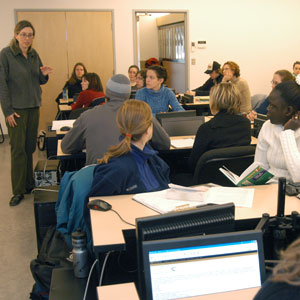
| Photo: Marie-Jos沤e Hamel, of the French Department, is implementing Computer Assisted Language Learning (CALL), to assist with language instruction. |
When new faculty member Marie-Jos沤e Hamel joined the French Department this summer, she wasn't too thrilled with the existing computer language lab. While its layout was suitable for individual learning and lectures, it did not have the flexibility for switching between them, or for small group interaction so important to the learning of a language.
Marie-Josee decided to implement CALL technology to assist with the language learning. "The role of Computer Assisted Language Learning (CALL) technology in language learning and teaching is that of a facilitator. It opens up the classroom walls; providing an environment rich in authentic linguistic resources - spoken and written ones - and instant feedback, which language learners should be able to attend at any time during their language learning experience. In order to enhance language acquisition opportunities, CALL technology is best deployed in a flexible classroom where learners work to and from the computers, individually and collaboratively, at their own pace, on constructive language-oriented tasks, their autonomy being driven and guided by their language tutor. Such a classroom facility is highly desirable when learning and teaching a language. Hired as a specialist in CALL, I took for my first mandate to promote this model in our Faculty of Arts and Social Sciences, so that 9 1免费版下 would be in a strong position to take an innovative role in the domain," Marie-Josie said.
Initially, the language departments reviewed several other classroom/labs throughout North America, but none of them, including Harvard's model, seemed to meet their needs. Led by Associate Dean of FASS, Shirley Tillotson, their representatives met with Mary Jane Adams of Facilities Management, Randy Barkhouse of Computing Services, and Carol O'Neil of the Centre for Learning and Teaching and, through many conversations and discussions it was determined that the only viable way to provide the desired facility was to modify furniture, the standard computer LCD panel, and cabling. An agreement to proceed with the project was reached in mid-November.
Located in the McCain Building, the new flexible classroom allows up to 36 students to engage in individual or group work, facilitated by computers as required. Gone is a classroom arranged in typical row fashion, replaced by six u-shaped pods where the computer screens and keyboards can in a few seconds be brought out and put away as needed.
Several Facilities Management staff, led by Nicola Embleton-Lake, "invented on a schedule" to source components and adapt existing tables to the need for a room that could allow students and faculty to switch quickly between computer use and other learning and teaching strategies. The proposal went from concept to reality in a few weeks from late November to the start of January. Embleton-Lake noted: "The conversion of McCain 2104 was a very fast-tracked project that required everyone's honest effort to see its completion on time. Everyone on the team including suppliers worked extremely hard to deliver."
A prime mover in the project was Associate V-P Academic, Dr Larry Maloney. "The demand for computer equipped teaching space has grown dramatically during the past few years and 9 1免费版下's ability to respond has been limited, especially with regard to large enrolment classes. This particular project drew on the good will and cooperation of various sectors of the university in order to serve not only the specific needs of language departments but also to serve, in part, the growing needs of large enrolment classes in other academic units. If the current model proves to be as useful as expected, replication will serve to satisfy language instruction needs and go a long way to addressing the needs of large enrolment classes across campus."
Another strong proponent was Carol O'Neil, Associate Director of 9 1免费版下's Centre for Learning and Teaching. The Centre, led by Dr Lynn Taylor, collaborates with colleagues from across the university to respond to the growing demand for technology-assisted learning facilities and more generally, to develop new models of classrooms to improve learning and teaching. As Ms. O'Neil observed, "Some of the most significant learning experiences occur when students are actively engaged (discussing, solving problems, simulating, collaborating, experimenting, constructing, practicing. Teachers and students need access to physical environments that allow such activities to take place. Flexible learning environments, like the new McCain classroom, can be easily reconfigured to accommodate a variety of teaching and learning methods, including the use of computers and other learning technologies. We hope that this is but the first in a number of such spaces at 9 1免费版下 so that we can continue to provide our students with innovative and effective learning experiences."
"Our Distributed Sites group, led by Alan Thomson, which will be responsible for ongoing computer support in addition to the recent installation of systems and software, was set up almost 20 years ago to assist in applying across campus lessons learned in the use of academic technology. This site provides an opportunity not only to draw on our experience, but also to add to it. The several modes of communication and interaction possible in this room, technology assisted or not, such as Net Support School and RealVNC, can be examples for others to consider," notes Randy Barkhouse, of ACS.
Although further adjustments to the classroom will be made early in the term, Professor Hamel is enthusiastic about the improved learning experience she and her colleagues will now be able to provide 9 1免费版下 students. "I believe we now have a true flexible classroom, a unique CALL facility our language learners and tutors at 9 1免费版下 will fully be able to benefit from, and that will be the envy of many other CALL users and researchers in the country. Thanks to real collaborative and creative efforts from all participants including colleague Donna Rogers of Spanish, Dean of FASS Marian Binkley, Marc Dooley of Networks and Systems, and many others."